

Words
When words don’t need to be explained

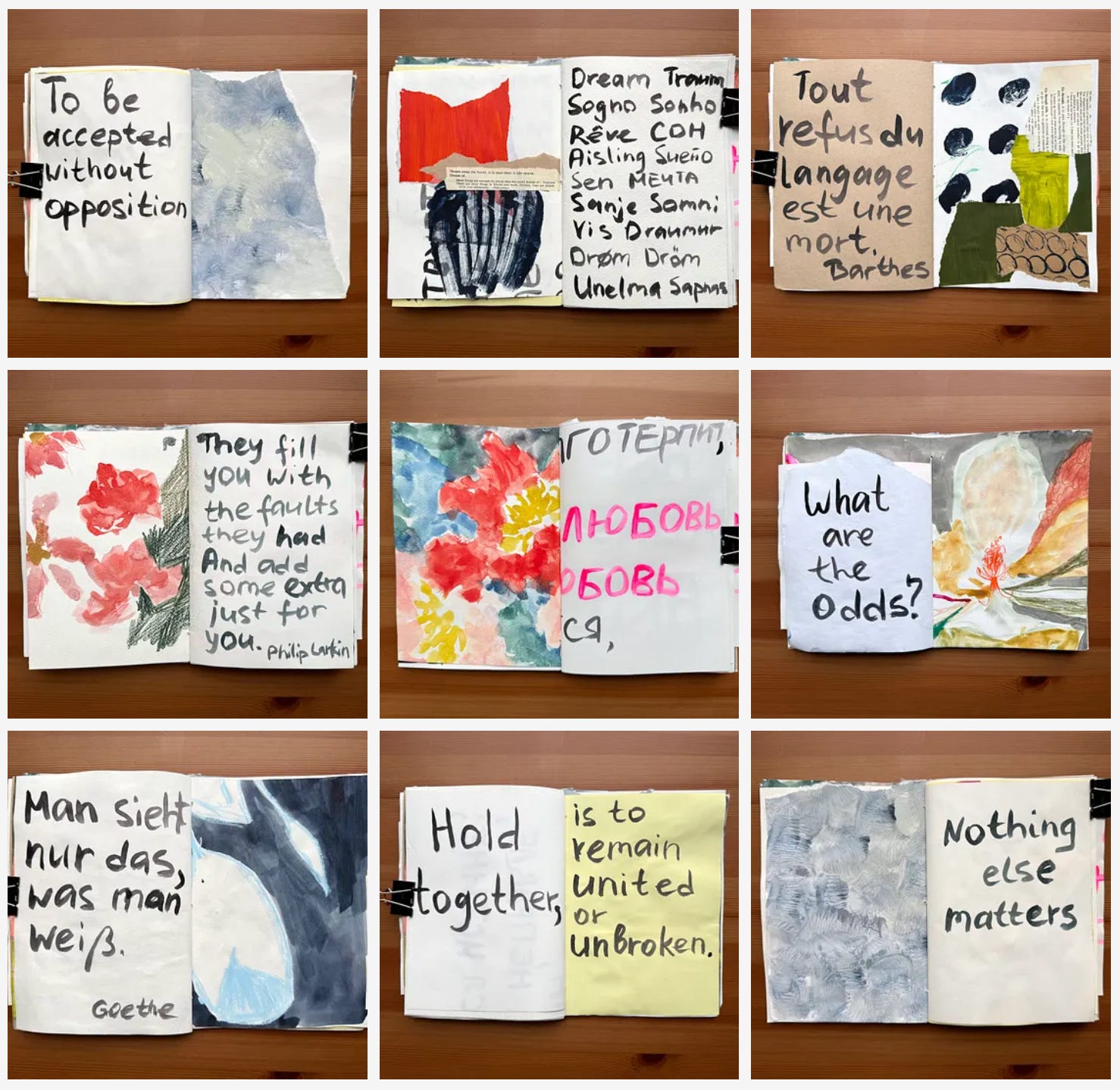
I think all creatives go through periods when they don’t like what they make or are not sure about the direction they take or choices they make. I surely do. Writing is one of the ways I process my feelings during such periods and I think of writing as an essential part of my art practice.
Around 10 years ago I had a notebook where I was writing down single words, phrases, poems, verses, quotes, etc. in different languages, even if I didn’t know the languages. I don’t speak French, for example, but I would write down something in French, if I wanted to keep the text in its original form (like song lyrics or a famous quote). Sometimes I would write down a phrase or a word, translate it to several languages and repeat it on the page several times.
The interesting thing is that the “meaning” would change with time for me, because the circumstances also changed. I’d look at the quotes with a fresh eye each time I reached for the notebook.
Unfortunately, this notebook didn’t survive, but I feel the urge to come back to this practice in a new way.
I have been hearing a lot of conversations lately about how in our age of rationality more and more people want to come back to real experiences, feel things more intensely, including when engaging with all forms of art. This idea resonates with me a lot. I had a course on philosophy focused on hermeneutics (understanding & interpretation of ideas) and I was especially interested in the approaches alternative to hermeneutics - e.g. by Gumbrecht who suggested focusing on experiences instead of interpretations, by Husserl whose idea was that phenomena must be understood intuitively, and by Barthes who explored signs (both words and images) and suggested that meaning is subjective and interpretative, not inherent.
I was drawn to these approaches as I am skeptical that there is one objective way to interpret art. We were led to believe that one needs some “special” knowledge to understand and appreciate art, but for each viewer the experience of the artwork will have its nuance and will depend both on personal preferences and external influences.
I asked myself: Does it make sense then that we focus so much on interpretation and meaning?
This is when I remembered my old notebook and an idea started developing in my head.
How does the fact that the same text is written in several languages change the experience?
How do you interpret the meaning without knowing the context? Do you even need to interpret it in any specific way?
Does it matter why I personally chose this phrase? Or is your experience the most important part?
If I take someone’s words and present them in a new visual way (in a sketchbook, on canvas, paired with imagery), take the words out of the context - how does the experience change?
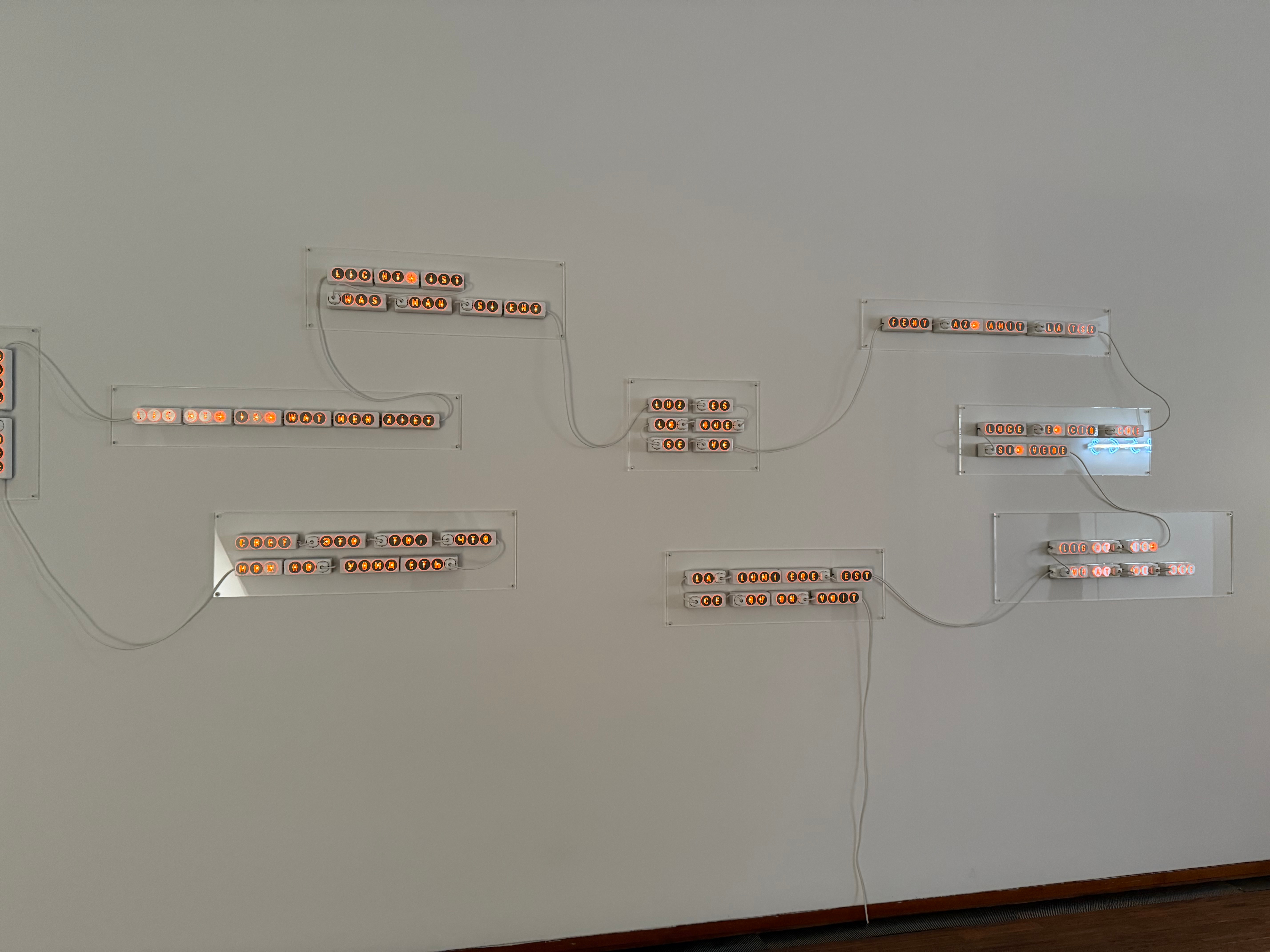
Of course, if it’s not a painting in a traditional sense - not a landscape, but a text - you can probably understand what’s written (or first translate it) and you can find where it is from if it’s a quote. But what if you give the first priority to the immediate experience and not to interpretation? The image above is from my recent visit of the Albertina Museum in Vienna, where the artist, Brigitte Kowanz, seems to have had a similar idea. “Light is what we see” is the name of the exhibition and it’s also the phrase that is repeated on this wall in different languages. Does it matter which language it is if it is light that we see?
What if we stop trying to immediately interpret the author’s intention or even the text itself? What if the words are just meant to be stood in front of? What if meaning should give way to experience, when words don’t need to be explained or interpreted?
A couple of days ago I made a little book from some studies, papers and other scraps and started writing down phrases and words into it in ink. Would you and me perceive what is written in the same way? Probably not. I myself probably have a different experience looking at these phrases today than I had yesterday.
I like playing with the idea of reimagining language as a medium of creating an experience rather than communicating a specific “message”. Nothing we create goes to waste. My notebook is long gone, but the idea lives and is developing in a new direction.
Thank you for reading and being part of this space. If you enjoyed this post, feel free to give it a like, leave a comment, or share it with someone who might appreciate it. I always love hearing from you in the comments - How do you relate to text in visual art?
If you haven’t yet, consider subscribing to stay connected. Everyone is welcome here!
You might also like:


Until next time!
Lisa
It feels to me that you are making art even if it’s not in your usual way and maybe this return to write words/quotes have a deeper meaning Lisa❤️ I love seeing lettering in journals, simple or combined with paintings or illustrations!
Great post and love reading how you are taking something which wasn’t a great time for you and exploring it further… the evolution of art and ideas definitely excited me too… and we all know at the end of the day, as soon as you release it to the Universe it’s out of our hands.
Can’t wait to see where this goes… I love languages and communication …. And art. So exciting!